feature-dev for Claude Code: review, how it works and whether it is worth it (2026)
Before you start
- 10 min read
Boxes marked Run in terminal are what you type; plain text explains why.
What you get in one minute#
feature-dev is Anthropic's free plugin that turns one command, /feature-dev, into a seven-step routine (explore the code, ask questions, design, build, review), and it is worth it for multi-file features but not for small fixes.

Logo: the official Claude Code logo from Anthropic's press kit (anthropic.com/press-kit)
The marketplace page shows 256,017 installs (October 2026). It is small: one prompt file and three subagent files, no scripts, no hooks.
| Verdict | Detail |
|---|---|
| Useful? | Mostly. Good for features that touch several files or start vague; wasted effort on small tasks. |
| Best for | Developers working in an existing codebase who want questions and a design to approve before any code. |
| Skip it if | You use the plugin for quick fixes, have a tight usage limit, or want Opus-level subagents (they are pinned to Sonnet). |
| Made by | Anthropic, Apache 2.0 licence file. |
| Version + date | No version in plugin.json or the marketplace entry. Folder content unchanged since December 2025 except a licence file (February 2026). |
| Install command | /plugin install feature-dev@claude-plugins-official |
| Token cost | No published figure; run claude plugin details feature-dev. The command prompt is about 5 KB (our estimate: roughly 1,300 tokens when you run it); the real cost is up to 9 subagent runs per feature. |
What it does#
You type /feature-dev Add rate limiting to the API and Claude stops being a code writer first: it explores, asks, proposes designs and only then codes. It waits for you at three points.
Added by the plugin:
- 1 slash command:
/feature-dev(optional description of the feature). - 3 subagents:
code-explorer(traces how existing code works),code-architect(writes a build blueprint),code-reviewer(finds bugs, reports only confidence 80 or higher). You can also call each by hand ("launch code-reviewer on my changes"). - 0 skills, 0 hooks, 0 MCP servers.
How it works in the background#
One long prompt is the whole engine: Claude Code loads it as instructions, and it tells Claude when to launch subagents and when to stop and ask you. The picture follows one feature.

- Your three stops: answer the questions (step 6), pick an approach (step 8), decide what to fix (step 11).
- Parallel agents: the prompt asks for 2-3 explorers, 2-3 architects and 3 reviewers, so 7 to 9 subagent runs.
- Writing code happens in your main session, not in a subagent.
It is all written instructions; nothing forces Claude to follow a phase.
Under the hood: dissection#
feature-dev is 100% Markdown: no code at all runs by itself, so there is nothing to execute except what Claude decides to do with the prompt.
The file tree#
feature-dev/
├── .claude-plugin/
│   └── plugin.json          name, description, author (no version)
├── commands/
│   └── feature-dev.md       the 7-phase prompt, 125 lines
├── agents/
│   ├── code-explorer.md     yellow, model: sonnet
│   ├── code-architect.md    green, model: sonnet
│   └── code-reviewer.md     red, model: sonnet
├── LICENSE                  Apache 2.0
└── README.md                documentation only, 412 lines
What each file is#
| File | Language | What it does | When it runs |
|---|---|---|---|
.claude-plugin/plugin.json | JSON | Names the plugin | On load |
commands/feature-dev.md | Markdown prompt | The seven phases, rules and agent instructions | When you type /feature-dev |
agents/*.md | Markdown + YAML header | Role, tool list and model of each subagent | When Claude launches that subagent |
README.md | Markdown | Explains the workflow to humans | Never loaded |
Key excerpts#
commands/feature-dev.md, Phase 3:
**CRITICAL**: This is one of the most important phases. DO NOT SKIP.
agents/code-reviewer.md, the header and the filter:
tools: Glob, Grep, LS, Read, NotebookRead, WebFetch, TodoWrite, WebSearch, KillShell, BashOutput
model: sonnet
...
**Only report issues with confidence ≥ 80.**
Disk and network#
- Writes: nothing itself. The code you approve is written by Claude with your normal permissions.
- Network: no calls from the plugin; the subagents list
WebFetchandWebSearch, which Claude may use. - Needs: a git repository (the reviewer looks at
git diffby default) and an existing codebase.
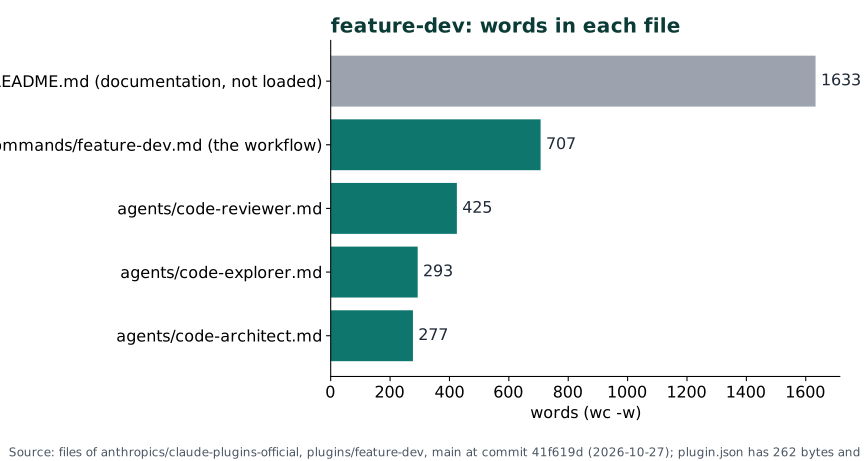
Chart: word counts of the files in plugins/feature-dev at commit 41f619d of anthropics/claude-plugins-official, read 27 October 2026. Only the grey README is never loaded.
What users say#
19 user reports read: 3 praise, 4 mixed, 12 complaints, but the split is skewed. GitHub issues attract complaints. Reddit could not be read, so it is not counted; one blog (Medium) returned an error and is not counted either.
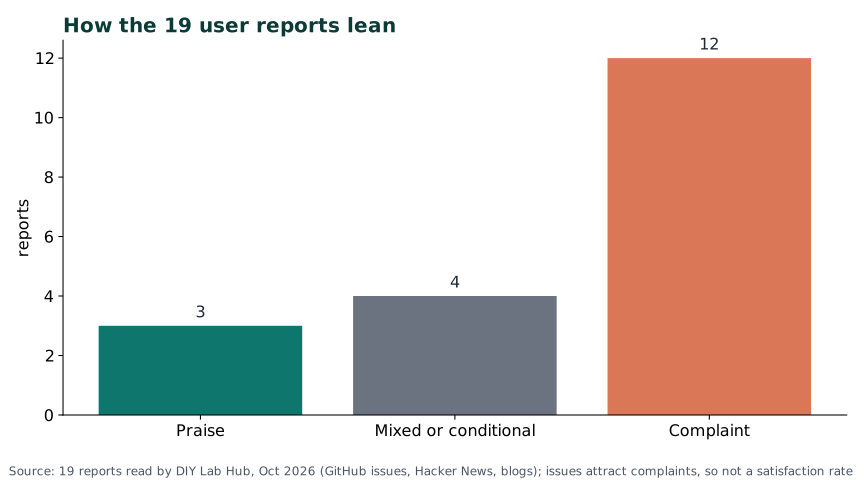
Chart: our count of the 19 reports, October 2026. Not a satisfaction rate.
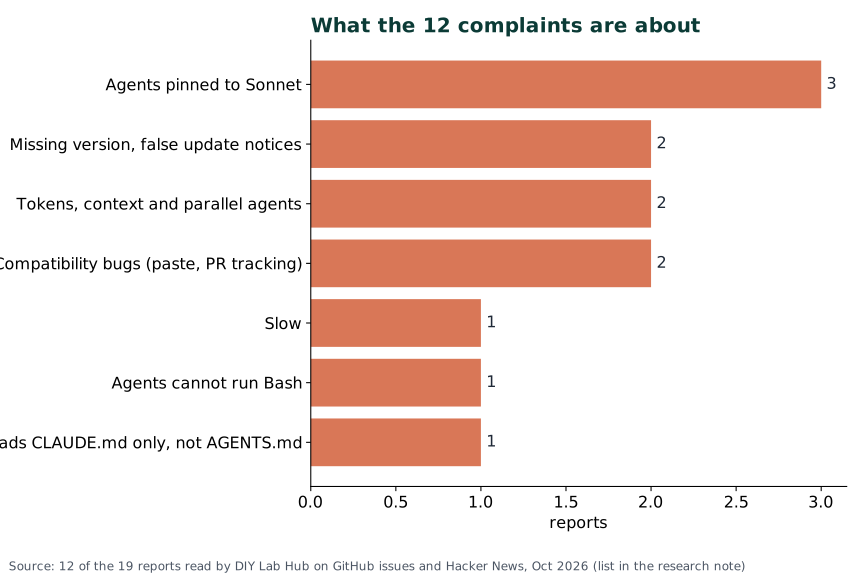
Chart: themes of the 12 complaints, labelled by DIY Lab Hub, October 2026.
| Voice | What they say |
|---|---|
| Praise | A blogger (December 2025) sees fewer errors and less back-and-forth; a Hacker News commenter (March 2026) built a 28-tool MCP server with it in about an hour. |
| Mixed | A guide (updated September 2026) likes the checkpoints but says to skip trivial work and huge refactors. Requests (March 2026) ask for smaller PR steps and a dry run. |
| Slow | A Hacker News commenter (February 2026) says it is so slow they sit idle. |
| Tokens | An issue (December 2025): one big feature nearly filled the 200k window. Another issue (February 2026): the 3+3+3 agents override a user's "at most 1 agent" rule. |
| Model | Three requests (1, 2, 3, December 2025 to January 2026) want Opus or the session model, not Sonnet. |
| Bugs | No Bash in the agents' tools (July 2026); missing version causes false update notices (July 2026); Ctrl+V broken on Windows (June 2026, closed as inactive). |
Pros: why it is useful#
It forces the thinking that vague prompts skip, and it costs you nothing but usage.
- Questions before design: Phase 3 is marked "DO NOT SKIP", so Claude cannot guess your requirements.
- Three designs to compare (minimal, clean, pragmatic) with a recommendation, before any code.
- Review with a threshold: the reviewer reports only confidence 80 or higher, so fewer nitpicks.
- Nothing to trust blindly: no scripts or hooks; you can read all 256 lines of prompt in minutes.
- Reusable parts: the three agents work on their own, useful even if you never run the full flow.
Cons: why it is not useful#
It is a heavy routine with a pinned cheaper model, and it cannot tell that your task is small.
- Cost and speed: up to 9 subagent runs per feature, and complaints about slowness and context.
- Sonnet is hard-coded (
model: sonnet). The docs say an omitted model follows your session; here it does not. - Stale agent definitions: the tool list has no
Bashand a reporter says four names no longer resolve; the plugin is unchanged since 2025. - Can override your limits: the "launch 3 agents" text beat a user's "at most 1 agent" rule, and the reviewer names
CLAUDE.md, notAGENTS.md. - Overlap with plan mode and the
code-reviewplugin; no version number, so update notices can repeat.
Should you consider it? When it is useful#
Consider it for features that touch several files or start vague; skip it for fixes, and try it on one real feature first.

| Situation | Verdict |
|---|---|
| New feature in an unfamiliar codebase | Install; the explorers pay for themselves |
| Vague request ("add caching") | Install; Phase 3 sharpens it |
| Review of code you wrote | Use code-reviewer by hand |
| One-line fix, hotfix, rename | Skip it |
| Tight usage limit | Call agents by hand, watch /usage |
Install and check it#
You install it from Anthropic's official marketplace with one command, inside Claude Code or from your shell.
Linux#
Inside Claude Code:
/plugin install feature-dev@claude-plugins-official
Or from your shell:
claude plugin install feature-dev@claude-plugins-official
Windows (PowerShell)#
No Bash or Git hook is needed (the plugin has no scripts), but the reviewer expects a git repository:
claude plugin install feature-dev@claude-plugins-official
Mac (Terminal)#
Same command as Linux:
claude plugin install feature-dev@claude-plugins-official
Check it worked#
claude plugin list
claude plugin details feature-dev
Then open a git project and type /feature-dev with a small idea; Claude should create a to-do list and ask what you want before it reads any code.
Things to keep in mind#
- Security. A plugin can change how Claude behaves. This one has no hooks, scripts or MCP servers, and the subagents lack
Write; the code is written by your main session under your usual permission prompts. - Usage. Parallel Sonnet subagents add up on big repositories; start with one real feature.
- Updates. With no version number, Claude Code compares commit IDs, so it may say "updated" without changes (issue 3571).
- Conflicts. Overlaps with
superpowersandcode-review; install one workflow plugin at a time. - Organisations can limit marketplaces; if install is refused, ask yours.
Troubleshooting#
| Problem | Solution |
|---|---|
Plugin "feature-dev" not found. Run claude plugin list to see installed plugins | Install first, using the full name feature-dev@claude-plugins-official. |
/feature-dev is not listed | Run /reload-plugins or restart Claude Code. |
| Repeated "updated, run reload-plugins" notices | Known missing-version issue; harmless, nothing in the plugin changed. |
| Ctrl+V stops pasting on Windows | Reported June 2026 and closed as inactive; set the plugin to disabled and restart to confirm, then follow the issue. |
| Too many agents or too slow | Name the feature clearly, say "whatever you think is best" to cut questions, or call one agent by hand. |
FAQ#
Is feature-dev made by Anthropic? Yes. It lives in Anthropic's own claude-plugins-official repository, author "Anthropic".
Can I use only the agents? Yes. Ask Claude to "launch code-explorer to trace how login works" or "launch code-reviewer on my changes".
Can I make the agents use Opus? Not without editing: the model is set in each agent file. Copy a file to your own agents folder and change model:.
How is it different from plan mode? Plan mode makes one plan; this runs separate exploration, design and review steps and stops for your answers between them.
Sources#
- Plugin files: command, three agents, README,
plugin.json, read at commit 41f619d (27 October 2026); marketplace.json entry. - feature-dev on the Claude marketplace: install count and listed components (October 2026).
- Official Claude Code docs: Create custom subagents, Plugin commands reference, Measure plugin cost, Plugin security and trust (October 2026).
- User reports: issues 3571, 163, 383, 4235, 256, 294, 6307 and 75066, 64395, 30845, 30843, 24932, 13968, 15849 (December 2025 to September 2026); Hacker News 46929320, 47395989, 46975980 (February to March 2026); Tom Ashworth (December 2025); Leanware (updated September 2026).
Not run by DIY Lab Hub: we read the files and docs but did not install the plugin on a test machine.
Checked against the official docs on 2026-10-27