Claude Security for Claude Code: review, how it works and whether it is worth it (2026)
Before you start
- 10 min read
Boxes marked Run in terminal are what you type; plain text explains why.
What you get in one minute#
Claude Security is Anthropic's own plugin that scans your code for vulnerabilities with a team of agents that try to disprove every finding; it is worth it for a deep check of code you own before a release, but it is expensive in usage and not for everyday use.

Logo: the official Claude Code logo from Anthropic's press kit (anthropic.com/press-kit)
The marketplace page shows 8,580 installs (October 2026). The plugin is in beta.
| Verdict | Detail |
|---|---|
| Useful? | Niche, but good at that niche. A scoped deep scan before a release; poor as a routine check. |
| Best for | Developers and small teams with a paid plan who want a security review of their own repository, with patches they apply themselves. |
| Skip it if | Your usage limit is tight, you scan code you do not trust (no sandbox), or you only want warnings while you type. |
| Made by | Anthropic, in its official marketplace. The licence is proprietary ("all rights reserved"), not open source. |
| Version + date | 0.12.0 (25 September 2026); the repository was read at its 27 October 2026 state. |
| Install command | /plugin install claude-security@claude-plugins-official |
| Token cost | No figure published. Each scan counts toward your usage; users report hitting a 5-hour limit within minutes on large scans. |
What it does#
You run /claude-security, pick a job, and a scan writes a report folder into your repository.
| Job | What it scans | What you get |
|---|---|---|
| Scan codebase | The whole repository or one area | Report, JSONL, SARIF, revision stamp |
| Scan changes | A branch diff, a pull request or one commit | Same files, only flaws the change takes part in |
| Suggest patches | The findings of a report | One F<n>.patch per finding you can apply with git apply |
Effort tiers are low (one researcher, then the panel), medium (the default) and high (more passes). Added by the plugin: 1 skill, 9 agents, 1 workflow, 4 hook events, 0 MCP servers, one command.
How it works in the background#
One skill runs the conversation, one JavaScript workflow fans the work out to agents, and Python scripts do the counting so the model cannot inflate its own results.

- Steps 5 to 7 run as the
claude-security:scanworkflow, shown live in/workflows. - The panel has three voters with different lenses (reachability, impact, defenses) and a 2-of-3 rule. Their instruction starts with "Default to FALSE_POSITIVE."
Under the hood: dissection#
About half the plugin is Python (208 KB) that does bookkeeping and reporting, and half is Markdown prompts (194 KB) that tell the agents how to behave. We read all 46 files at commit ca08d5e.
The file tree#
claude-security/
├── .claude-plugin/plugin.json       name, version 0.12.0, author Anthropic
├── hooks/
│   ├── hooks.json                   4 hook events
│   ├── hooks.sh                     picks a Python 3.9+ and runs hooks.py
│   └── hooks.py                     banner, usage counts, scan tip, 60 s timeout
├── skills/claude-security/
│   ├── SKILL.md                     the front-desk menu
│   ├── role.md                      the "Security Lead" rules
│   ├── jobs/ scan-codebase.md, scan-changes.md, suggest-patches.md
│   └── specs/ report-spec.md, patch-spec.md
├── agents/                          9 agents (below)
├── workflows/scan.js                the scan pipeline, minified, 60 KB
├── scripts/
│   ├── write_scan_meta.py, save_result.py, render_report.py, patch_artifacts.py
│   ├── keep-waiting.sh
│   └── lib/                         14 helpers (SARIF, CWE, findings, strict JSON)
├── README.md, SECURITY.md, NOTICE.md, LICENSE
What each file is#
| File | Language | What it does | When it runs |
|---|---|---|---|
hooks/hooks.json, hooks.sh, hooks.py | JSON, shell, Python | Banner, usage counts, scan tip, cost-question timeout | Menu opens, after Bash, on questions |
SKILL.md, role.md, jobs/*.md, specs/*.md | Markdown | The menu, the rules, one recipe per job, report and patch formats | When you run the command |
agents/*.md | Markdown | 9 agents (researcher, verifier, inventory, redactor, patch writer ...) | Dispatched by the workflow |
workflows/scan.js | JavaScript | Sizes the scan, runs researchers and the panel | During a scan |
scripts/*.py | Python | Stamp the commit, tally votes, render files, build patches | Between agent steps |
Two key excerpts#
hooks/hooks.json (shortened) runs a tip after a push or a new pull request:
"PostToolUse": [{ "matcher": "Bash", "hooks": [
  { "command": "sh \"${CLAUDE_PLUGIN_ROOT}/hooks/hooks.sh\" tip push || true",
    "if": "Bash(git push *)", "timeout": 5 } ] }]
agents/scan-verifier.md: tells each voter to "try to disprove it".
Models, disk and network#
- Models: most agents use your session model; inventory, loader, redactor and
exploreuse Sonnet. - Writes: one
CLAUDE-SECURITY-<time>/folder and scratch clones for patches. - Network: none in the scripts; the optional pull-request list uses
ghif allowed. - Needs:
python33.9+, git for change scans and patches, dynamic workflows.
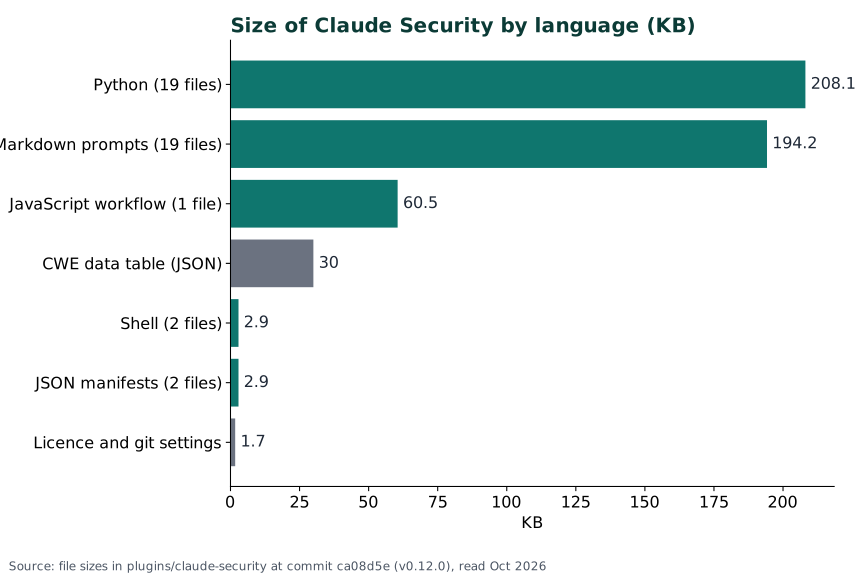
Chart: file sizes in plugins/claude-security at commit ca08d5e, read in October 2026.
What users say#
18 reports read: 2 praise, 5 mixed or neutral, 11 complaints, and the split is skewed. Reddit was not read; one Medium post was blocked (403), so only its title counts.
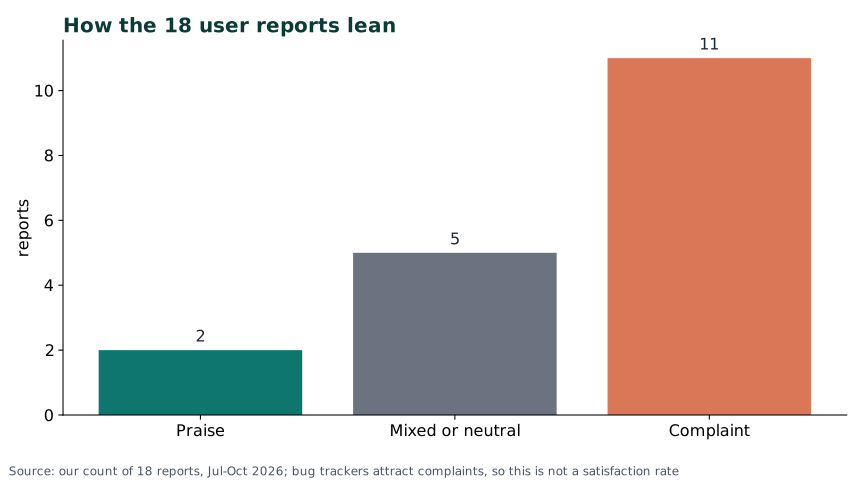
Chart: our count of the 18 reports, July to October 2026. Not a satisfaction rate.
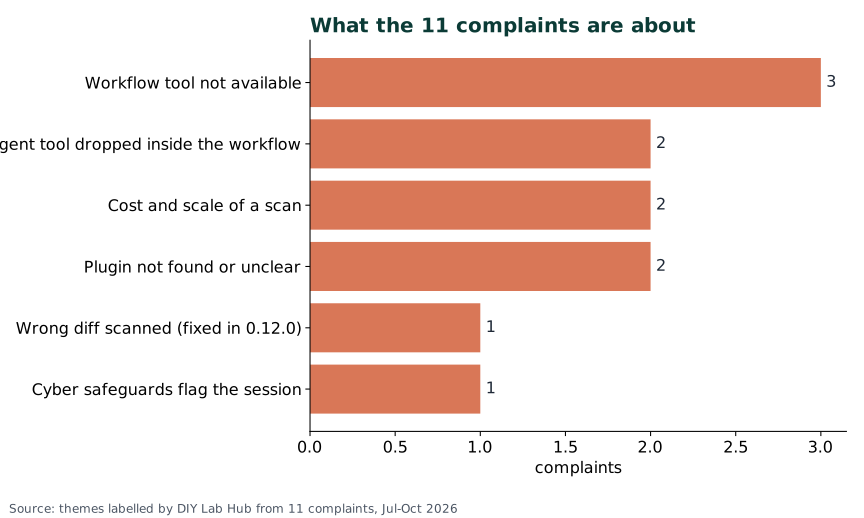
Chart: themes of the 11 complaints, labelled by DIY Lab Hub.
| Voice | What they say |
|---|---|
| Praise | A hands-on writer (September 2026) scanned an old codebase and calls it better than rule-based scanners; the page is paywalled. |
| Cost | A Classmethod test (July 2026) hit the 5-hour limit in about 15 minutes; one GitHub report (July 2026) saw 95 agents over 2.5 hours on 208 files. |
| Cannot run | Issue 4415 (July 2026): the Workflow tool is missing; issue 104581 (October 2026) is the same after a restart. |
| Fixed | Issue 92317 (September 2026): a change scan read the wrong diff; Anthropic says 0.12.0 fixes it. |
Pros: why it is useful#
It looks for real attack paths and shows its work, which is what you want from a security review.
- Short reports: a finding must survive three verifiers and a 2-of-3 vote, so you read fewer false alarms (Anthropic's claim; no independent false-positive rate exists).
- Honest numbers: Python computes the tally, and the report lists what was not examined.
- Safe by design: it never applies, commits or pushes; patches are built in a scratch clone and reviewed.
- Free to install, runs on your own checkout, also on Bedrock, Vertex and Foundry.
Cons: why it is not useful#
It is a heavy, beta tool that can eat a day's usage, and it is not a sandbox.
- Cost is unpredictable: verifiers scale with candidates and there is no time limit (a maintainer says this is intended).
- Setup friction: Workflow tool problems blocked several first runs.
- Nondeterministic: two scans can differ.
- No isolation: a hostile repository's
.claude/hooks apply as usual (its SECURITY.md says so). - Overlaps with
/security-reviewandsecurity-guidance; no SAST replacement.
Should you consider it? When it is useful#
Consider it for a scoped deep scan of your own code before a release or a big merge, and skip it as a daily tool. Start with one area or one branch diff.

| Situation | Verdict |
|---|---|
| Release or audit of your own repository | Install; scan area by area |
| Everyday warnings while Claude writes code | Skip; use security-guidance |
| A third-party repository you do not trust | Only inside a sandbox |
| Tight usage limit | Skip, or low on one folder |
Install and check it#
You install it from Anthropic's official marketplace with one command.
Linux#
Inside Claude Code:
/plugin install claude-security@claude-plugins-official
/reload-plugins
Check python3 --version shows 3.9 or newer first.
Windows (PowerShell)#
Make sure python3 runs, then start claude and enter the same two lines. Hooks start with sh, so install Git for Windows if the menu warns (our reading, not tested).
python3 --version
claude
Mac (Terminal)#
python3 --version
claude
Then enter the install lines from the Linux section at the prompt.
Check it worked#
Run /claude-security: a banner and a three-option menu appear. Run /model first (the README recommends Opus 5.5 or Fable 5.1). A cheap first test: /claude-security scan my branch at low.
Things to keep in mind#
- Security. It runs under your permissions with no isolation. Sandbox untrusted code (sandbox-runtime).
- Secrets. A model masks credentials in the report on a best-effort basis; read it before sharing.
- Privacy. Usage counts go through Claude Code telemetry;
DISABLE_TELEMETRY=1stops them,CLAUDE_SECURITY_SCAN_TIP=offstops the push tip. - Licence. Proprietary: internal use with Anthropic products only.
- Updates. No version pin, so it auto-updates; behaviour changed between 0.10 and 0.12.
Troubleshooting#
| Problem | Solution |
|---|---|
Marketplace "claude-plugins-official" not found | /plugin marketplace add anthropics/claude-plugins-official, then install again. |
Plugin "claude-security" not found in marketplace "claude-plugins-official" | /plugin marketplace update claude-plugins-official, then retry. |
| Menu warns it needs python3 3.9 or newer | Put a newer python3 first on PATH, start a new session. |
No such tool available: Workflow. Workflow is not available inside subagents. | Run /claude-security in your main session, not as a subagent; on Pro turn on Dynamic workflows in /config. |
The scan pipeline is unavailable in this session (it needs the Workflow tool) | Same fix; if it persists, see issue 104581. |
No answer after 60 seconds, so nothing was run. | Run the scan again and answer the cost question. |
| Usage limit hit very fast | Scan one area, use low, or scan only a branch diff. |
FAQ#
Is this the hosted Claude Security product? No. That one is for Enterprise and can use Claude Mythos; the plugin uses your Claude Code models.
Does it change my code? No. It writes a report folder and, if you ask, patch files you apply yourself.
How is it different from security-guidance? That plugin warns while Claude writes code; this one does an on-demand deep scan.
Does my code leave my machine? The model in your session reads it, as in any Claude Code work; the scripts open no connections.
Sources#
- plugins/claude-security: 46 files and marketplace entry, commit ca08d5e (October 2026).
- Marketplace page (install count) and product page (October 2026).
- Official docs: Claude Security, workflows, plugin security (October 2026).
- User reports, GitHub: 4415, 4428, 6606, 81018, 80281, 88151, 92317, 102096, 104581, 104448 (July to October 2026).
- User reports, web: Classmethod, AI Disruption, Build Fast with AI, Valletta Software, Pasquale Pillitteri, Cyber Security News, Medium post (title only), Hacker News thread (July to September 2026).
Not run by DIY Lab Hub: we read the files and docs but did not install the plugin or run a scan.
Checked against the official docs on 2026-10-27